Tag Archives: mothering

New Year’s State of Mind

butterfly-picture

The concept of New Year’s Resolutions has declined in popularity, hopefully showing that as a culture, we are realizing making decisions to do things differently, backed by an underlying tone of shame and only needing to apply more effort, does not create effective, satisfying change. Characteristics we do not like about ourselves can attach to us much more firmly when we frame them as something we need to lose. Rather than try to change who we are, let’s change how we view ourselves to become more accepting of ourselves and others. As we come to accept how each of us is unique, and yet all the same, what we thought of as stubborn habits may melt away into a beauty that shines so brightly from within us, all who interact with us will only see our gifts and talents.

Listed below are some states of mind that help us all shine more brightly.

1. I am who I am.

The list of what we would like to change about ourselves can be long. A great place to start is by really accepting, “I am who I am.” Perhaps I frequently arrive late to events. Shaming and criticizing myself doesn’t help me get anywhere faster. Accepting that I am a person who has a more fluid view of time than others provides me with more peace for this characteristic about myself. Once I feel peace with myself while preparing to go to a destination, I have more presence of mind to actually be present in the moment and see that it’s time for me to leave the house.

2. In this present moment, all is well.

Eckhart Tolle’s book, The Power of Now, is a great game-changer for what is in people’s heads much of the time. Apparently the thoughts streaming through our minds are consistently about the past and the future. With our minds remaining in times outside of now, we are able to remain in a constant states of crisis. We think about everything that has gone wrong in the past, and the future is open to so many more possibilities for life’s problems. However, the actual, present moment, not a minute from now, is completely okay. Stay in the moment that is happening, taking calm, deep breaths, and give your body a chance to stop pumping the adrenaline and pressure on yourself.

3. To let go of judging myself, I will avoid judging others.

Of course we all judge people. To say to never judge again would not be possible. The unfortunate part about judging others is that it causes us to continue to judge our own selves more harshly. In the moment, it may feel better to judge another person and think we are in some way superior. The long-term problem is that we then assume everyone else is judging us. Then we drop into feelings of disgust for the aspects of ourselves we assume are being judged.

Accept others. Assume the best. This shift in thinking will help us realize we all are human and that we can accept who we are as well.

4. I feel what I feel.

We all experience happiness, sadness, excitement, anger, and all of the other feelings. There might be a moment of angry rage that doesn’t make sense. Don’t judge the feeling. Know that everyone sometimes goes through these weird emotions that may not match the situation. Just honor the feeling, note that the source of what it felt is likely from something unrelated to the current situation, and gently give time for the feeling to subside.

river-and-sunset

5. I will do more of what brings me joy.

This is not as much a state of mind but conscious permission to honor what gives you pleasure. Perhaps you like being alone, reading, window shopping, going to parties, hosting parties, writing, golfing, meditating, spending time with friends, organizing, running around your house naked, or anything else. Do the things that make you happy, allowing you to feel more in touch with who you are, honoring yourself.

Happy 2017!

Valentine’s Eve Eve Frenzy

Running HeartFebruary 13th is the last school day before Valentine’s Day, so at home my kids and I are preparing their valentines on the evening of the 12th. Our family is recovering from a week-long illness, and I am fortunate that my mother-in-law took my kids to shop for loving characters of their choice earlier this week. I know she was thinking ahead for me by getting each kid a box of valentines that already had a matching tattoo in it. No need to add a piece of candy or some other small bonus with the card. Minimal work for the mom in a rush. Not that our valentines would have been picked out any differently if there had been no illness in our home and I had purchased them myself – we are consistent in our skill to patiently wait until the deadline to complete a task in our family. Actually, it’s only me who has the gift of patience. My husband is driven to accomplish tasks ahead of schedule. No need to focus on his weaknesses, though. Still, looking at the box, I felt comfort in knowing a class of completed valentines was just a step away.

My plan was to open a box for each of the kids, set them up on the table, and let them add their own special touch to each card. My son would write his name on his, and my daughter would place a sticker on hers.  Simple and fast. Unfortunately, a visual scan of the actual contents of the box revealed there was much more prep work waiting just for me. All of the valentines had to be separated. All of the tattoos had to be cut apart. Then all of the tattoos had to gently eased into two not-as-precise-as-I-would-like slits on the valentine. Resisting my urge to abandon ship, I spent the next hour carefully placing all the tattoos inside each valentine, narrowly avoiding ruining each one as the clear paper on top threatened to separate from the tattoo is was protecting. Whew!

Finally it was time to call in the kids to do their part. I figured my daughter would have an easy enough time placing one heart sticker on each card and that my son might get frustrated with having to write his name somany times. Should I hover and watch? What if they mess up the tattoos? What if my son writes in the wrong place? What if my daughter takes everything apart? I decided to walk out of the room and let fate decide the designated destination for those notes of love.

IMG_1240Once I returned, I was surprised to find that my son had quickly created an organizational system to write his name on each card and and place it in a “completed” pile. My daughter, however, felt that rather than one heart sticker per card, she should decorate with eight to twelve heart stickers per card. She did run out of hearts, but I found some smiley face stickers for the other valentines. We survived!

For a family attempting to dodge all the crafty aspects of a holiday, we still managed to get rather involved. Perhaps the manufacturer’s of these “easy” cards are actually designing them with more work to keep people from cheating? It seems there’s cultural pressure to stop and give thought to the love and care that’s being expressed. Would it be easier to break out the construction paper and make our own cards? Could I find a quick and easy idea on Pinterest? Who knows? I’ll start thinking about ideas for my kids’ cards next year, the night before Valentine’s Day.

Breastfeeding: Wading Through Advice and Resources to Find Your Way to Success

Photo by Crickett Photography

Photo by Crickett Photography

From the moment I put my first baby to the breast, the advice started. Nurses, doctors, lactation consultants, relatives, friends, strangers, instructional books, discussions on the Internet, support groups, my dissatisfied baby; they all had something important for me to make sure I followed! I didn’t know it right away, but some information was helpful and would be essential to continuing my breastfeeding relationship with my baby. And other advice, strict rules, warnings, and “helpful” suggestions, if attempted, could have resulted in more challenges and possibly the end of breastfeeding for me. I feel fortunate that I was able to wade through all of the contradicting resources and find the information that was helpful for me.

It’s frustrating, but sometimes the professionals who you would think you should trust the most can be the most harmful by providing incorrect information. To initially manage the influx of advice, it can be helpful to consider everyone, no matter the credentials, as a resource you are consulting, not the final expert!

I asked some breastfeeding women to share examples of questionable or harmful suggestions they received from different sources so I could present a more clear picture of the confusing, contradictory, and inappropriate advice women are being told by their healthcare providers and loved ones:

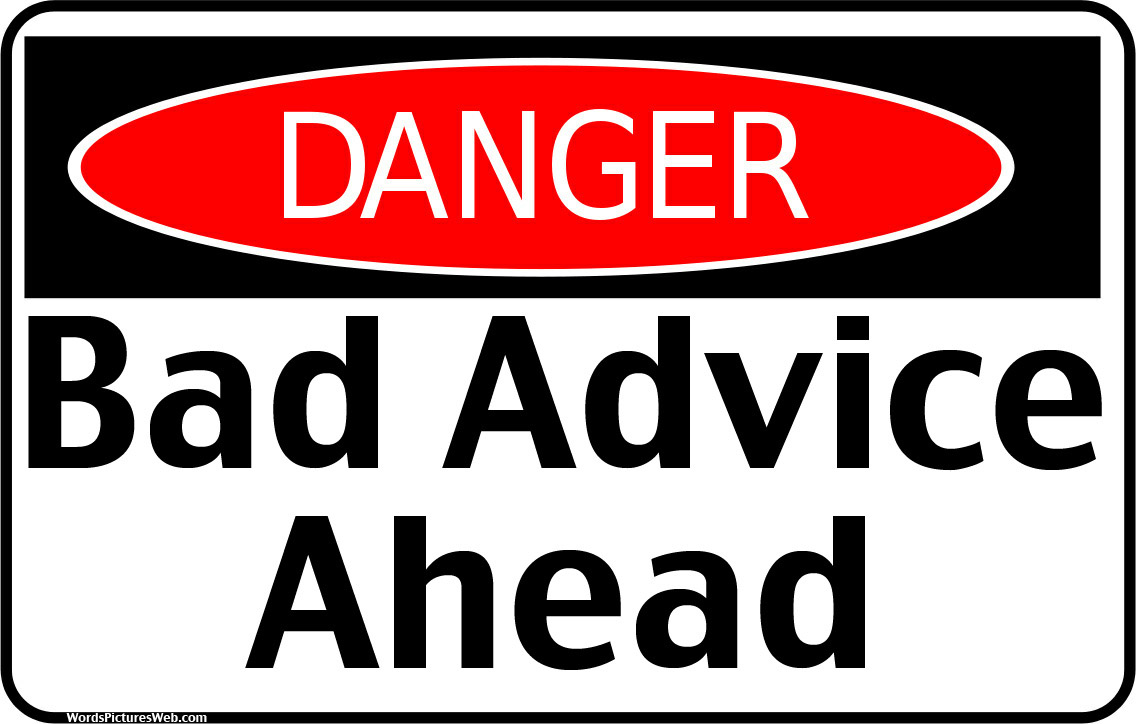
Danger Bad Advice Ahead


“Yes, I can prescribe that, but I would just stop breastfeeding,” suggested by an OB.


Statements from different pediatricians:

“In our practice, we don’t clip a tongue-tie until breastfeeding fails.” In this case, breastfeeding was on the verge of failing.

“Breastfeeding just ‘isn’t in the cards’ for some people.”

“Just get over it and rip those scabs off.”

“He’s not gaining weight because he’s probably anemic from not giving him an iron supplement.” This baby had an undiagnosed tongue-tie.

“He can’t be allergic to foods other than soy and dairy.”

“Dairy sensitivity is ‘just a fad.'”

“Some babies are sensitive to dairy but nothing else.”

“If he’s not latching correctly, you just need to not let him nurse to show him who’s boss!”

“Give him solids at five months to improve his weight gain.”

“Many moms like to take a weekend at a hotel and leave baby with family.” This was suggested for a one-week-old.

“You should supplement your baby with formula instead of your pumped breast milk.”

“Your baby is nursing way too long. You should stop and give him a pacifier.”

“A six-month-old baby cannot live on breast milk alone. You are starving her by not giving her solids or formula.”

“The benefits of breastfeeding past a couple of months are debatable.”

“Give your baby cereal to sleep through the night.”

“Since your 2.5 month is in the 98th percentile for weight, you can let her cry at night because she obviously doesn’t need night feedings anymore.”

“Babies need to get used to formula anyway, so you may as well start now.”


Statements from lactation consultants and nurses:

“He’s so big; there is no way you can make enough milk to feed him.”

“Your NICU baby will never be able to nurse and you could never keep up pumping, so why bother?” This baby did breastfeed, and this mom had thousands of ounces in extra milk to donate to other babies while feeding her own baby.

“Your baby was just born. There’s no way she’s hungry already.”

“Tongue tie is just a trend.”

“Use sugar water to get him to latch.”

“Your baby won’t latch? She’s being lazy and stubborn, so you just need to be more stubborn than her and force her to latch. She will stop crying eventually and get it.”

“Breastmilk won’t help jaundice. Give the baby formula in a bottle, 60mls, every two hours to flush it out.” This baby was two days old.

“I don’t see a problem with the latch. Just keep using hydrogels.”

“You’re doing it wrong, and when you’re open to help, let me know.” Breastfeeding was actually going well.

“Yeah, it will probably hurt for the first few weeks until you get used to it.” This baby had an undiagnosed tongue-tie.

“Don’t let him use you as a pacifier.”

“I’m sure your latch is fine.” The LC wasn’t watching the baby nurse!


Statements from other professionals, family, friends, and strangers:

“It would be so much easier if you would just give her a bottle.”

“If her latch is bad, why don’t you just give her formula?”

“Give your six-week-old cereal to help him sleep better.”

“Give him water when he wakes up at night to help him start sleeping.”

“You are overfeeding and that’s why your daughter is spitting and has gas. You should nurse her less.” Actually the mom had overactive let-down and oversupply.

“She nurses too much. You’re spoiling her.”

“You have to feed on both sides every time.”

“Make sure you hold your breast down with your finger so she doesn’t suffocate.” This led to mastitis.

“Just switch to formula so your life is easier.”

“Use a toothbrush to scrub nipples and toughen them up before the baby comes.”

“Stop nursing her while you have the flu so your baby doesn’t get sick.”

“I have a lip-tie and I’m fine.”

“You can’t lactate during pregnancy. Either your milk will dry up or you will have a miscarriage.”

“You should wean at a year because, well, that’s what you do with bottles!”

“Didn’t you just breastfeed her? Well she probably needs a bottle then.”


These statements aren’t shared to discourage you from seeking help. In some cases, you may not be sure why the advice is unhelpful and may need to research to find out more about certain breastfeeding challenges. However, being knowledgable that credentials or experience do not always equal expert knowledge about breastfeeding can help you discern where to find your information.

Breastfeeding BabyWhere do you find the accurate and appropriate breastfeeding information? If possible, start your research during pregnancy. Find a local La Leche League, Breastfeeding USA, or other breastfeeding-focused group. Go to the meetings, socialize with the women, and find out which professionals in your area are truly helpful. If you’re unable to find recommended local help for your questions, consider checking with well-trusted websites. Some good examples include http://www.llli.orghttps://breastfeedingusa.org, and http://kellymom.com. Join online breastfeeding support groups to gain broad feedback about your questions. If you choose to follow advice, do your own research before making a change. This is when you’ve hopefully already found a recommended IBCLC or other professional you can trust to help you with finding evidence-based research.

Another step toward a successful breastfeeding relationship is to listen to yourself. Are you trying to make a change because you are truly worried or because other people are telling you to be worried? On the other side, are you ignoring a possible problem because you honestly feel everything is fine or because others are reassuring you all is well? Listen to yourself and listen to professionals who speak to your instinct. Follow up your decisions by checking on evidence-based research, and you can feel confident you are taking the right steps! 

—————————————————————————————-

I want to add a disclaimer for women, who for any reason, are not breastfeeding their babies. Wether you made the decision to not breastfeed, you were unable to find adequate support, you have a unique health status that affects breastfeeding, or if all of your hard work to make breastfeeding happen did not result in a nursing baby, you are an absolutely awesome mom who loves her baby! While this post is about helping mothers find success in breastfeeding, it is not meant to imply any negativity toward those who do not breastfeed. All moms and all mothering styles need support and respect!

Parenting Priorities

Photo by Crickett Photography

Photo by Crickett Photography

Like so many parents, my goal for each of my children, starting at birth, has been to give them the best possible childhood experience to help them grow up into productive and happy people who posses an intrinsic zest for life. At times when one of my babies was peacefully sleeping with all immediate needs met, thoughts of successful, well-balanced people I admired came to mind. At other times, when my bundle of joy was nearly inconsolable and demanding I remain awake all night to a point where I wasn’t sure why I willingly chose to have a child, images of unhappy, angry, or sad people who must have not gotten the consistent parenting they needed growing up flooded my mind.

We’ve all been told there’s no manual for parenthood, but I have wondered if there isn’t at least a loose set of instructions that if followed, will prevent me from ruining my children? So much advice and research suggest the sense of security we as parents seek. Perhaps picking a philosophy and following all of the accompanying rules is the way to go? Still, when looking at the end result of all the parenting methods available, there is no guarantee of positive results. This leaves me wondering how to make my parenting decisions without later regretting them.

It took me a while to realize it, but my parenting philosophy not only has to resonate with my beliefs and the personality of my child, but it also has to make use of my strengths and sources of energy. If you go with a parenting style that requires a strict schedule or routine but have significant trouble following a consistent plan yourself, you may have difficulty with maintaining the routine. Or, the parent who needs a schedule to feel functional throughout his or her day would likely struggle uniquely planning every day around his or her child’s expressed needs. In my situation, I wanted to follow a daily routine that my child appeared to need, but my natural tendency to change plans frequently as opportunities become available or stop as rest is needed resulted in me needing to compromise. Fortunately, both of my children are content with a very loose routine and unexpected changes. They know I will plan ahead to meet their needs of food, rest, and opportunities to release energy as they arise. We schedule events and attend them but do not follow a consistent plan. For us, my need for flexibility and my children’s needs for some predictability are fulfilled to the best of my ability.

I feel content with my laid-back parenting until I see someone else with a similar style but displaying more thought and effort; more attention to detail. It might be that I pull out a processed, packaged snack for my child at the park and see that my respected friend is giving her daughter sliced fruit in a reusable snack bag. Or at another person’s house, I might witness a boy who is told he can’t watch TV happily choosing from three parent-prepared independent activities that will all stimulate his mind. It’s not too difficult for me to stop my children from watching television, but I am overwhelmed at the thought of always having fun and educational alternatives available for them. At times, I am desperate for my children to watch TV or to please do the one activity available just so I can finish my own tasks. Does this mean I’m a bad parent? No, it means that I am my children’s parent – one of the two parents guiding our kids through what they are meant to experience in this world.

Wait, I’m still stressed about how some children are getting the superior experience of parents who seem to handle life better and are more consistently prepared to meet their children’s needs than I am! My kids could be at a disadvantage because I don’t have the energy to make every moment special and meaningful! Then I realize that first, I don’t know what other families do when they are alone, and more importantly, that I have different strengths I don’t acknowledge. I only see my weaknesses and how other people are able to be better parents than I am. Having an awareness that parenting abilities in my mind are exaggerated as better or worse, depending on if I’m thinking about myself or someone else, helps me keep my overall perspective more evenly balanced.

Photo by Crickett Photography

Photo by Crickett Photography

A strategy I use to reconcile my frustrations when I’m encountered with feeling inadequate is to consider if an activity or idea I’ve witnessed could realistically fit into my own parenting repertoire. If I cannot see what I view to be a superior parenting ability aligning with my strength or source of energy, I let it go and maintain admiration for the other parent’s ability to be so clever, thoughtful, or disciplined. If I think this new idea could fit into my life, but it still sounds overwhelming, I put it on a list of ideas to be considered later when I’m not so overwhelmed. We all continuously improve ourselves one slow step at a time in between long stretches of survival. It’s okay to see a change you want to make and save it for a less stressful time.

Recently I have realized that more importantly than any particular aspect of my parenting, how I treat myself is what my children are internalizing. If I feel self-critical for what I cannot do, my children learn to have their own inner voice of self-criticism. If I continuously overlook my own needs to only focus on what’s in my children’s best interest, my children will ultimately learn to overlook their own needs to focus on others. Knowing that my children will become what I model, I make every effort to balance being accepting my needs and who I am while also giving back to my children and others. Because I want the best for my children, I must live my life as the productive and happy person who posseses an intrinsic zest for life – the end result I want for my kids. By learning about my own priorities for success and happiness, I am able to teach my kids who I hope they will be when they become adults!

Photo by Crickett Photography

Photo by Crickett Photography

10 Things You Never Thought You Would Do Before Becoming a Parent

1. Eat half a banana that was abandoned on the floor.

2. Realize you haven’t had a shower in two days and then decide that you’re probably okay waiting another day.

3. Post a picture of poop on the Internet for verification of health or illness.

4. Make a serious plan to have the neighbor’s dog abducted after sudden, loud barking wokeRobot Costume up your baby or toddler at the beginning of a nap.

5. Enthusiastically approve your child’s request to wear a costume to the mall if that means he will be pleasant and agreeable to all of your requests for several hours.

6. Clean up vomit that has just arrived on the dinner table, followed by finishing the interrupted meal as if nothing more than a glass of water has been spilled.

7. Notice someone has wiped their hands and nose on your shirt but feeling like it’s still good enough to wear for the rest of the day.

8. Keep the car endlessly stocked with a never-ending supply of goldfish or similar mouth-filling snack.

9. Hand your thirsty child a juice box that you think was opened yesterday but could have been opened three days ago.

10. Look at another parent in public struggling with his or her highly emotional child, and instead of judging, thinking, “Hang in there! We’re all on the same team, and being in public with your kid is about survival!”